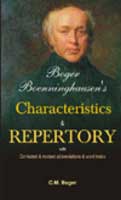
Use of Constitutional types from Boger Boenninghausen’s Repertory

Use of Constitutional types from Boger Boenninghausen’s Repertory

The historic development of constitutional types in Homoeopathy began with a change in Hahnemann’s own pattern of thinking. Hahnemann (1810) initially advocated similarity of symptoms as the sole basis to select the most suitable curative remedy. Some years later (1816-17) he became convinced that this was not adequate for treating chronic diseases.
Misconceptions about Homoeopathy

In the present era after getting fed up with the unwanted effects and reactions of the so called modern medicine, a large number of people are seen converging towards Homoeopathy in prospect that Homoeopathic medicines are safer and cause no or little side effects. There are still numerous false notions that hinder the acceptance of Homoeopathy in general public.

Appendicitis :: Acute Appendicitis and Homoeopathy

Appendicitis is a common and urgent surgical illness with variable manifestations, generous overlap with other clinical syndromes, and significant morbidity, which increases with diagnostic delay. No single sign, symptom, or diagnostic test accurately makes the diagnosis of appendiceal inflammation in all cases. The surgeon’s goals are to evaluate a relatively small population of patients referred for suspected appendicitis and to minimize the negative appendectomy rate without increasing the incidence of perforation.

Hahnemann in Mirror of Astrology

Hahnemann in Mirror of Astrology

Samuel Christian Hahnemann was by any standards a glorious eccentric, and his restless life story is mirrored in the chronological headlines.

Alcoholism :: Homeopathy and Alcoholism

Alcoholism can fall into two separate categories: problem drinking and actual physical dependence on alcohol. Problem drinking is commonly emotional in its roots, whereby the alcoholic uses drink to avoid feeling. Alcohol dependence is where the person needs alcohol in order to function.

Meningitis :: Homeopathy and Meningitis

Meningitis is the inflammation of the meninges, the membranes that surround the brain and spinal cord. Meningitis may be caused by a physical injury or trauma, a reaction to certain drugs or allergy, or more commonly, infection by certain viruses, bacteria, fungi, or parasites. This article chiefly focuses on meningitis caused by viral or bacterial infection. Most cases of both viral and bacterial meningitis occur in the first five years of life.

Siddha :: Alternative medicine – Siddha Medicine – Introduction

Siddha system is one of the oldest systems of medicine in India. The term ‘Siddha’ means achievement and the ‘Siddhars’ were saintly figures who achieved results in medicine through the practice of Yoga. Eighteen ‘Siddhars’ seem to have contributed towards the development of this medical system.

Malandrinum

It is made from the “Grease” a disease seen in horses. It is a nosode first proved and introduced by Boskowitz of Brooklyn who made the first potencies up to the 30th. It was later proved by Drs. Straube (using 30th potency), Raue, Carleton Smith, Wm. Jefferson, Guernsey, Selfridge, Burnett and Clarke. An extensive proving was carried out by W. P. Wesselhoeft, H.C. Allen, Steere, Holcombe and the students of Hering College in 1900 – 1901. They used 30th, 35th and 200th potencies.

Dr. Anil Singhal Homeopathic Doctor | Dr. Anil Singhal's Blog | Manan - My Memoir by Dr. Anil Singhal | Boger's Legacy | Organon of Medicine | Health Newstrack